
Written by Samir Baydoun | Power Plants
Exhaust silencers operating in high-temperature environments (1000–1250°F) face significant thermal, mechanical, and metallurgical challenges. Elevated temperatures can change material properties, reduce structural strength, and induce failure mechanisms that must be accounted for in design.
To ensure reliable silencer performance and life expectancy, exhaust silencer designs require careful consideration of material property changes, design load requirements, design verification methods, and finite element analysis (FEA).
Material Property Changes at High Temperature
Before performing detailed design or analysis, it is essential to understand how the silencer’s materials behave under prolonged exposure to high temperatures. Stainless steels used in silencer construction may undergo creep, temper embrittlement, and graphitization. These mechanisms significantly influence allowable stresses and required design margins.
Creep and Creep-Rupture
Above approximately 1050°F, stainless steel exhibits creep, where strain increases over time under constant load. As a result, the material’s effective strength becomes strain-rate dependent rather than purely yield-based.
- Creep: Time-dependent plastic deformation under a sustained load
- Creep-rupture: Failure occurring at stresses well below ambient-temperature yield strength after a fixed time at elevated temperature
Creep-rupture strength must be evaluated based on the expected silencer life. This is particularly critical for silencers exposed to continuous high-temperature flows.
Temper Embrittlement
Temper embrittlement occurs when steels are aged at elevated temperatures, causing impurities to segregate along grain boundaries. This results in:
- Reduced toughness
- Increased susceptibility to cracking
- Higher risk of brittle failure, especially in the heat-affected zone (HAZ) near welds
Embrittlement must be considered when selecting materials and establishing welding procedures.
Graphitization
Graphitization affects carbon-rich steels exposed to temperatures above 750°F. Carbon atoms precipitate as graphite particles along grain boundaries, causing:
- Loss of ductility
- Reduced tensile strength
- Premature intergranular fracture
- Failure at weakened grain boundaries
Design Loads
In addition to dead load and seismic load requirements, silencers must be designed to handle thermal loads and flow-induced mechanical loads.
Thermal Loads
Rapid temperature increases from ambient to operating conditions create thermal gradients within the silencer structure. Because the frame is restrained and cannot expand freely, thermal expansion generates significant stress.
These stresses can:
- Concentrate at joints, corners, and stiffeners
- Accelerate creep deformation
- Exceed allowable stress limits
Accurate thermal stress analysis is therefore essential.
Flow-Induced Side Loads and Vibration
High-velocity exhaust flow can induce side loads and structural vibration.
- Turning vanes or flow straighteners upstream of the silencer help reduce load magnitude.
- However, flow side loads cannot be eliminated and must be included in structural analysis.
- Computational Fluid Dynamics (CFD) is used to determine load distribution and location.
Because flow-induced forces can vary significantly depending on operating conditions and exhaust duct geometry, vibration effects must also be considered when evaluating long-term silencer durability.
Design Verification Requirements for Replacement Exhaust Silencers
Choosing a replacement exhaust silencer involves more than matching dimensions or meeting noise requirements. For high-temperature applications, the design must be able to handle heat, vibration, and years of continuous service without developing structural problems.
One of the first things to consider is material selection. The materials used throughout the silencer must be able to withstand high temperatures while resisting creep, thermal fatigue, and other forms of heat-related deterioration. Choosing materials based primarily on price rather than operating conditions can shorten the life of the equipment and increase maintenance costs.
Support systems and attachment methods deserve equal attention. Baffles, sheet metal components, and structural supports are all exposed to vibration and thermal expansion. If these elements are not properly designed, stress can build up over time and lead to cracking or other structural issues.
Engineers should also take a close look at the insulation system. The acoustical insulation must be protected from both heat and exhaust flow so it remains in place and continues to perform as intended. In high-velocity exhaust streams, additional protection may be necessary to prevent erosion or displacement of the insulation over time.
Support structures should be evaluated to ensure they can withstand both thermal and mechanical loads without distortion or fatigue cracking. Likewise, welding procedures and welding consumables must be selected specifically for the operating environment. Even a well-designed silencer can experience premature failure if critical welds are not executed using appropriate materials and procedures.
Finite Element Analysis (FEA)
To ensure structural performance under high-temperature conditions, both steady-state and transient thermal stress analyses are required.
Steady-State Thermal Stress Analysis
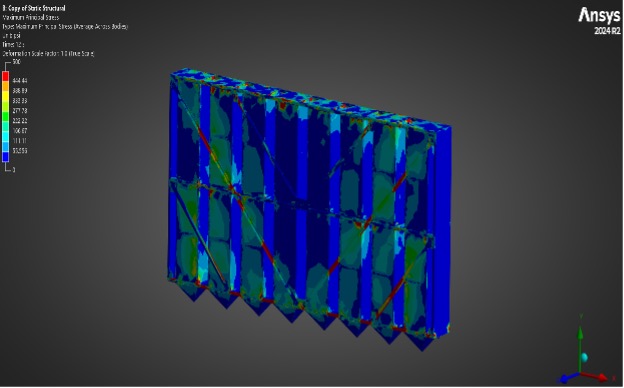
This analysis evaluates stress once the silencer has reached a constant design temperature.
Key purposes:
- Determine long-term stress
- Assess suitability against creep-rupture criteria
- Establish allowable life expectancy
Below is an example of a steady-state thermal stress FEA for a bar-type silencer performed using ANSYS.
Transient Thermal Stress Analysis
Transient analysis predicts stress during temperature ramp-up, which typically lasts about five minutes from ambient conditions to full design temperature.
This analysis provides:
- Thermal gradients over time
- Peak stresses during the startup period
- Identification of critical structural regions with high stresses
Example results from ANSYS are shown below.
After 2 minutes of startup

After 5 minutes of startup (design temperature 1250°F)

What Affects the Lifespan of an Exhaust Silencer?
How long an exhaust silencer lasts often comes down to how well it handles heat and vibration over time. One of the biggest challenges is thermal cycling. Every time a unit starts up and shuts down, the silencer heats up and cools down. Over the course of its life, that can mean thousands of cycles of expansion and contraction. Those repeated movements place stress on the frame, welds, and attachment points, eventually leading to fatigue if the design isn’t robust enough.
Startup conditions can be especially demanding because temperatures rise rapidly. As the silencer heats up, thermal stresses develop throughout the structure. Repeated exposure to those stresses over thousands of operating cycles can eventually cause cracking if the design isn’t properly engineered.
Exhaust flow can also take a toll over time. High-velocity gases create turbulence that causes components inside the silencer to vibrate. If those forces aren’t considered during the design process, repeated vibration can lead to cracking in baffles, supports, and welded connections, shortening the life of the equipment.
For that reason, silencer longevity depends on much more than material thickness alone. Frame design, material selection, support systems, attachment methods, and welding quality all play a role in determining how well a silencer performs over the long term.
Reliability Starts with Design
An exhaust silencer does much more than reduce noise. In high-temperature applications, it must also withstand years of heat, vibration, thermal cycling, and mechanical loading without compromising performance.
Achieving that level of reliability requires careful attention to every aspect of the design. Material selection, structural supports, insulation protection, attachment methods, and welding details all play a role in determining how well a silencer performs over the long term. Engineering tools such as CFD, finite element analysis, thermal fatigue studies, and creep evaluations help identify potential issues before a silencer is ever put into service.
By addressing these factors during the design process, plant operators can reduce maintenance requirements, extend equipment life, and lower the risk of unexpected outages.
If you’re evaluating a replacement exhaust silencer or planning an upcoming outage, SVI BREMCO can help ensure your design is built for long-term performance.