
Written by Tucker York | Plant Maintenance
Industrial noise control is a huge concern for all industrial plants, including power generation, chemical, and paper mills. There is a wide range of noise sources and acoustic issues in these settings. Machinery in industrial plants often creates both structure-borne sound and airborne sound. Acoustic barriers of various types are used to reduce direct and/or reverberant energy propagation and help keep noise from reflecting unnecessarily to other places in the workspace. Lessening noise and sound in open industrial applications fosters a safer and healthier work environment and compliance with safety standards and regulations.
Why Are Acoustic Barriers Needed in Industrial Settings?
Acoustic barriers help lower occupational exposure to high noise levels, creating a safe and productive workplace for employees. Excessive exposure to high sound levels can be hazardous to those exposed, ultimately affecting their health and hearing. Additionally, lowering noise levels helps improve communication efforts among employees and reduces worker fatigue.
Industrial facilities have to meet specific requirements regarding noise to maintain compliance with the standards set by the Occupational Safety and Health Administration (OSHA). OSHA regulations require that sound levels are within specific ranges for workplace safety. However, regardless of the specified requirements, maintaining lower noise levels is the right thing to do for the health and well-being of the workers.
Types of Acoustic Barriers Used in Industrial Plants
There are numerous possibilities for acoustically treating industrial plants or facilities. Depending on the exact application, acoustic barriers vary greatly in size, structure, and materials. Some acoustic barriers utilize concrete, foam cores, fibrous materials, or fabric to decrease noise levels. Two common types of acoustic barriers used in industrial settings are wall structures and enclosures.
Sound Wall Structure
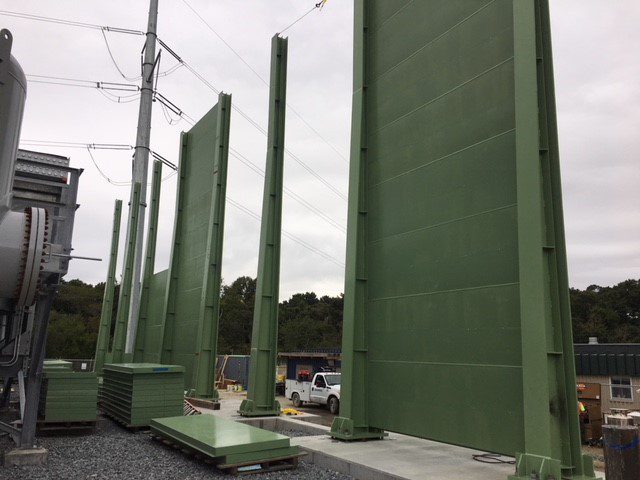
This type of acoustic barrier is a wall or structure that intercepts the direct sound path between the source and the receiver. The wall produces a “shadow zone” of lowered sound levels in the area behind the barrier. Sound wall structures are typically constructed of steel panels and columns. A sound barrier wall can be an effective solution for many industrial noise control equipment applications, though they are not typically recommended for indoor noise sources because indoor sound is often reflected around any barrier, and any benefit may be lost when the sound is transmitted outdoors.
Acoustic Enclosure
While wall structures are usually single large-area walls or two wall structures put together, an acoustic enclosure may be a partial enclosure (one with three or more walls), a complete enclosure, or a whole room. Enclosures offer the highest noise control and sound reduction level and are frequently made to specification to meet requirements for ventilation, equipment access, and useable floor space. Sound enclosures diffuse and absorb sound waves from inside the structure to effectively lower noise to acceptable levels.
Acoustic Barriers Benefit Workers and Facilities Alike
Reducing noise at an industrial plant doesn’t just benefit the safety of workers who are in the direct path of the noise. It also benefits employees in the rest of the plant as well as the facility owners. Caring for the well-being of workers promotes better morale and increased productivity in the plant.
Contact SVI and speak to one of our experts today to learn more about industrial acoustic barriers and how they can help your facility. Our team can help you understand the science behind noise control and how our acoustic barrier options can work to improve your facility’s operation.