

Written by Hussam Baydoun | Plant Maintenance
When it comes to industrial processes, everything is about safety and efficiency. Steam vent silencers are designed to safely and quietly discharge high-pressure steam into the atmosphere, ensuring that industrial plants comply with noise regulations and operate properly. But like all other machinery, steam vent silencers also require proper design and periodic inspections to avoid failure modes that can result in safety hazards or operational downtimes.
Here, we’ll analyze the structural aspects of steam vent silencers, focusing on design considerations, safety inspections, and common failures. Whether you’re an engineer, plant manager, or simply someone interested in industrial equipment, this guide will provide valuable insights into maintaining the structural integrity of these critical components.
What is a Steam Vent Silencer?
Before diving into the structural details, let’s start with the basics. A steam vent silencer is installed downstream of a relief valve to dampen the sound of high-pressure steam discharge. These silencers are typically mounted at elevated positions in plants, often called ‘sky vents,’ and are essential for noise control observation. The main components of a steam vent silencer are:
- Diffuser assembly with inlet pipe: This is for steam distribution and noise damping.
- Silencer shell: The outer casing, which may or may not contain a liner.
- Silencer inserts: internal elements that absorb sound and reduce noise levels.

The Importance of Structural Inspections
Regular inspection of steam vent silencers is important for safe and efficient operation. Some components deteriorate over time due to factors like thermal fatigue, corrosion, and mechanical stress. Here’s a breakdown of the inspection procedure and what to look for:
- Support Brackets and Welds: Check the support brackets and welds for any signs of corrosion or degradation. The welds must be free of cracks or other damage, as this can compromise the silencer’s structural integrity.
- Outer Shell: Corrosion, cracks, and thinning may lead to leakage or complete failure if left unchecked.
- Inlet Pipe: Inspect the inlet pipe bolts for loosening or missing, and check the welds for failure. The inlet pipe could also be subject to corrosion, particularly in areas with high moisture.
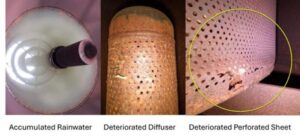
- Internal Components: Tools like GoPro cameras will be used to inspect the internal baffles and the diffuser basket. It may contain perforated sheets, frames, and supports that are probably corroded or cracked. The diffuser basket is liable to wear due to high-velocity steam flow and high pressure.
- Drainage System: The drainage pipe should be free and functional. Water accumulation can cause excessive corrosion, especially at the bottom of the silencer.

Common Structural Failures and Safety Concerns
Knowledge of common failure points in steam vent silencers will enable you to take steps to prevent such failures. The following are some of the most frequent failures:
- Deterioration of the perforated liner: The silencer’s perforated liner deteriorates with use over time, reducing acoustic insulation. Under unfavorable conditions, large portions of the perforated liner can separate and eject from the silencer, posing safety hazards.
- Cracks in the center body support: Cracks in the center body support can cause the structure to collapse, potentially blocking steam flow and even ejecting large silencer parts.
- Diffuser basket failure: Diffusers operate under extremely high-velocity and high-pressure steam conditions. The high pressure and thermal cycles will fatigue the perforated plates and cause cracks in the welds and frames. These issues can pose significant safety risks if parts break away and eject from the silencer.
- Corrosion due to water accumulation: When drainage fails, the silencer accumulates water at its bottom. As a result, extreme corrosion may lead to great material losses. It commonly occurs with silencers that are subjected to rain and condensation.
Root Causes of Structural Failures
To effectively avoid failures, their root causes should be known:
- Design and fabrication issues: The contribution of poor material selection, inadequate welding procedures, and suboptimal aerodynamic design to structural failures cannot be overestimated. For example, using materials that are too thin or not corrosion-resistant can lead to premature degradation.
- Thermal fatigue: Steam vent silencers are subjected to repeated thermal cycles that, over time, may weaken the materials. This is most true in very high-temperature environments.
- Inadequate inspection: Without routine inspections, small issues may go unnoticed and escalate into major failures. Regular checks are vital to spot problems and act in time.
Design Considerations for Structural Integrity
Designing steam vent silencers considers several aspects relating to structural integrity for their lifetime operation:
- Material selection: The materials used should be corrosion-resistant and capable of withstanding high temperatures. For this reason, stainless steel is usually a good choice for components such as the diffuser basket and perforated liner.
- Welding quality: All welding shall be of high quality and use the correct procedures and materials. Poor welding workmanship leads to premature cracking and failures under stress.
- Aerodynamic design: Back pressure and high velocity can lead to structural failure. CFD analysis and proper aerodynamic design are required to minimize the failure factors.
- Drain system: An efficient drainage system should be used to prevent water accumulation, which can lead to corrosion. The drain system must be well-maintained, too.
Prevent Safety Hazards and Downtime with Regular Inspections
Steam vent silencers are critical components of industrial setups, and maintaining their structural integrity is essential for the safe and efficient operation of plants. Proper designs, regular inspections, and proactive maintenance are keys to averting failures for long-term performance. You avoid costly downtime and safety hazards by understanding some common failure points and addressing those through thoughtful design and routine checks.
Let SVI BREMCO help you ensure your plant’s safety and continued operation. Contact us today to schedule your inspection.