

Written by Brad Buecker | Power Plants
Evaporator and superheater tube repairs in heat recovery steam generators (HRSGs) can be quite complicated due to the typical multi-pressure configuration. Unlike conventional coal-fired units, where the waterwall tubes form the boiler enclosure, the water/steam networks in HRSGs are of panel or “harp” design, with panels located side-by-side in each section of the steam generator. The figure below outlines the circuitry of a very common HRSG design for combined-cycle power units.

Although not shown in the diagram, HRSGs frequently include an ammonia injection grid (AIG), catalyst layers for nitrogen oxide (NOx) reduction, and a catalyst layer to lower carbon monoxide (CO) concentrations in the exhaust gas. SVI BREMCO provides AIG retrofits and catalyst replacements in addition to HRSG tube repairs.
The combination of hot, rapidly flowing flue gas through HRSG harps and frequent load cycling subjects the evaporator tubes and other components to significant thermal and mechanical stresses. Load cycling also affects water/steam chemistry, which in turn increases the risk of waterside corrosion and corrosion fatigue. Not surprisingly, periodic repairs and equipment replacement are necessary to maintain unit reliability. The following discussion highlights several important issues related to tube repair and replacement in a recent project in the Northeast.
Extraction and Repair of Evaporator Panels
The primary maintenance issue was the repair and retubing of the HP evaporator and drum riser tubes. Also necessary was the removal and reinstallation of AIG panels. These components had to be lifted out of the HRSG for repair at ground level.

Much preparatory work was necessary to access these components for extraction. Major items included removing structural steel, duct plates, and lagging, and insulation from the area above and around the HP drum and evaporator circuits, as well as the AIG panels. And, of course, the equipment to be extracted had to be firmly and safely attached to the crane cables when it was separated from the steam drum and headers, and support brackets. Lifts were subject to weather conditions, with delays at times due to high winds or other inclement weather.
New Panel Fabrication
SVI personnel performed panel tube repairs on site, as shown in Figure 3.

Fabrication of the new panels required accurate measurements and design to ensure that the components fit precisely within the existing structure.
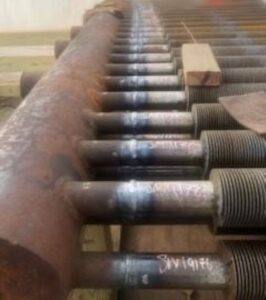
A key component of boiler part fabrication and reassembly is welding. Decades of experience have shown that welds, if not properly performed or with incorrect filler material, can become weak points and fail due to thermal/mechanical fatigue or, on the water/steam side, corrosion fatigue. Welds must conform to ASME Section IX pressure vessel guidelines, which often require inert gas welding, as was performed for this project. Figure 4 illustrates the evaporator tube welds to the lower header of one new panel.
Per standard procedure, SVI BREMCO engaged a third-party non-destructive evaluation (NDE) firm to confirm that all welds were of proper quality before reinstalling the panels. This was followed by 1,500-psi hydrostatic testing of completed panels.
Reassembly
The newly repaired and fabricated components required lifting and precise alignment for reattachment to the existing HRSG connection. Additional tube, header, support bracket, and structural steel welding were, of course, necessary to return the unit to operating condition. These welds also required inspection to ensure proper quality. Final work included the reinstallation of duct plates and insulation.
This report touches upon just some of the many issues regarding the maintenance of HRSG water/steam networks. SVI BREMCO has the expert staff to perform this complex work and to provide solutions for your other power plant maintenance needs. Please reach out to us today to discuss your power plant’s requirements.