
Written by Tucker York | Power Plants
To understand and assess dissipative and reactive silencer properties in rectangular or cylindrical exhaust ducts, SVI Dynamics, an SVI BREMCO company, uses a combination of 1-D algorithms, Boundary Element Method (BEM) modeling, and field verification studies. Each method is critical in the acoustic model correlation process, improving prediction accuracies for small to large turbine exhaust applications. This technical blog expands on using BEM as a computer-aided engineering tool, essential for maximizing silencer design efficiency.
How Does BEM Simplify the Modeling Process in Acoustic Engineering?
According to accepted engineering texts, BEM is a numerical computational technique for solving linear partial differential equations defined over complex geometries. In our applications, these geometries include parallel baffle silencer arrangements, bar silencer arrays, reactive silencer designs, lined rectangular ducts, and lined cylindrical ducts.
Unlike domain-based methods such as Finite Element Method (FEM) or Finite Difference Method (FDM), BEM requires discretization only of the boundary rather than the entire volume. This significantly reduces the dimensionality of the problem, leading to a smaller system of equations and, therefore, an improvement in computational efficiency. Adding to computational efficiency, many of the modeled systems at SVI BREMCO have a measure of symmetry and repeatability, further simplifying the modeling process.
What Are the Core Principles of BEM?
Boundary Element Method modeling has various core principles, including:
- Integral Formulation: BEM transforms partial differential equations into integral equations over the boundary of the element or system of elements. This is achieved using Green’s functions, which represent the influence of boundary points on the solution at any given point in the domain.
- Boundary Discretization: The boundary of the domain is discretized into elements (panels or segments). This reduces the problem dimensionality by one (3D problems become 2D on the boundary).
- System of Equations: The integral equations are transformed into a system of linear algebraic equations by applying boundary conditions and discretization, which are then solved for the unknown boundary values.
Why Use the BEM Method?
The SVI Dynamics company at SVI BREMCO uses BEM techniques for two reasons. First, reducing dimensionality by discretizing only the boundary of each modeled entity results in fewer elements and a corresponding reduction in computational resources.
Second, BEM results strongly correlate to controlled laboratory experiments examining sound transmission loss properties of absorptive and reactive silencers. BEM is known to have high accuracy when considering problems with smooth boundaries and definable acoustic wave propagation characteristics.
Optimizing Turbine Exhaust Silencers Using BEM
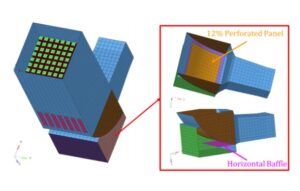
Exhaust silencers are the most critical component in reducing noise emissions to the surrounding environment for simple-cycle combustion turbine exhaust systems that do not include catalyst modules or any other mechanical elements in the flow path. In one specific case, SVI BREMCO was asked to reduce low-frequency acoustic energy and overall A-weighted sound pressure levels from a peaking power plant equipped with four large Westinghouse turbines. BEM was used to assess several exhaust system configurations, optimizing the analysis process until an acceptable solution was determined for the customer. Below is an illustration of a BEM model used to examine the lower frequency performance of an initial exhaust system concept (Illustration 2.1). Note the model’s simple “mesh” pattern and individual element size, focusing on understanding low-frequency, acoustic response characteristics. The model includes an assessment of parallel baffle geometries along with the introduction of a horizontally segregated resonance chamber at the base of the exhaust stack. Through an iterative BEM process, a final concept was reached that approximated the project’s goals. A concept that included a bar silencer array and tuned, multi-chamber resonator positioned under the exhaust stack elbow duct (Illustration 2.2).
Illustration 2.1: BEM Model Assessing Low-Frequency Acoustic Response (Original Concept)
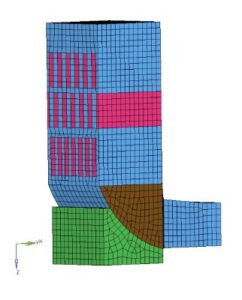
Illustration 2.2: BEM Model Assessing Low-Frequency Acoustic Response (Final Concept)
Advantages of BEM in Turbine Exhaust Noise Control
As demonstrated in the previous section, BEM offers distinct advantages in determining engineered solutions for combustion turbine exhaust applications:
- Acoustic Analysis: BEM is a known computational tool that offers precise solutions for industrial noise control applications, assuming the model inputs are precise.
- Noise Reduction Optimization: Very useful when comparing direct results for several iterations of modified silencing equipment. Geometries are optimized by analyzing the boundary’s acoustic impedance and altering designs to minimize noise transmission.
- Thermoacoustic Effects: Temperature gradients can affect sound propagation patterns in turbine applications. BEM incorporates high-temperature effects and the corresponding interaction between thermal and acoustic fields, yielding higher accuracy in acoustic predictions.
Let SVI BREMCO Help With Your Noise Control Needs
Boundary Element Method (BEM) modeling at SVI Dynamics, an SVI BREMCO company, has proven invaluable in designing and optimizing turbine exhaust silencers. By focusing on the boundary of complex geometries, BEM enables a reduction in computational resources while maintaining high accuracy in predicting acoustic behavior. The iterative BEM process ensures that silencers meet the required specifications, particularly in challenging environments like those of large-scale power plants. We invite you to explore the potential of BEM for your specific needs.
Contact SVI BREMCO today to discuss how we can enhance your acoustic engineering projects with cutting-edge BEM solutions. Let’s collaborate to reduce noise emissions effectively and efficiently.