

Written by Bill Kitterman | Plant Maintenance
Penetration seals are essential components wherever pipes or tubing pass through the ductwork of boilers or Heat Recovery Steam Generators (HRSGs). Because their main purpose is to contain high-temperature exhaust gases (900°F or more) within the exhaust duct, minimizing leakage is absolutely essential for both safety and operation.
While penetration seals play a critical role, their failures can pose complex challenges that require thorough technical evaluation of contributing factors.
Why Penetration Seals Fail
With 50–100 penetrations per plant, seal failures are a common maintenance issue. Here are the main causes of failure.
Thermal Cycling and Fatigue
Penetration seals endure temperatures over 1,000°F and up to 200 cycles a year. Each startup and shutdown forces the seal to expand and contract with the ductwork, liners, and piping, absorbing several inches of differential movement. This constant expansion and contraction lead to material fatigue, cracking, and loss of flexibility, making fatigue the most common cause of failure.
Normal Wear and Maintenance Cycles
Penetration seals require maintenance and regular replacement due to severe temperatures, gas velocity, and continual stress—even with proper installation.
How can you detect a problem with your penetration seals?
Prompt maintenance and timely replacement are crucial for minimizing operational disruptions and safety risks. The indicators below help identify potential issues with penetration seals.
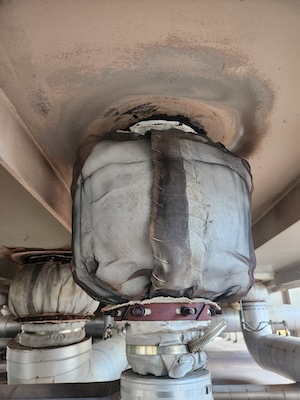
Visible Hot Spots or Burned Paint
A penetration seal problem may be noticed during operator walk-downs. Escaping gases create hot spots in the casing, causing blistered paint, discoloration, or heat. Because exhaust temperatures vary, surface heating can occur quickly once containment fails. These signs often mean gases are bypassing the seal and overheating the outer steel. When observed, further evaluation is needed—not just cosmetic repair.
Thermal Imaging and Temperature Trending
The most reliable way to detect seal failure is through thermal imaging, which uses infrared cameras to measure surface temperatures while the unit is online. Degradation often shows as rising casing temperatures. Trending is essential; for instance, an increase from 145°F to 300°F indicates an issue, even before visible failure. Regular thermal imaging and records help maintenance catch temperature changes before damage occurs.
Something More Could Be Wrong
Replacing a penetration seal without investigating the surrounding systems can solve the visible failure while leaving the underlying problem untouched. In many cases, the seal is the first component to fail because it is flexible and exposed, yet it reacts to stress generated elsewhere in the unit.
A common root cause is liner degradation. The liner is the metal sheet or plate that lines the interior surface of the ductwork for protection. Hot gas migrating underneath a loose liner can create pressure differentials and high-velocity flow, producing a Venturi effect—a localized reduction in pressure that results when a fluid flows through a constricted section of pipe or duct—which pulls insulation and generates hot spots. This uneven thermal profile can overload the penetration area. Replacing the seal without addressing liner looseness or insulation loss causes recurring stress and shortens the new seal’s life.
Overheating of the internal casing or liner can cause failure. Localized hot spots weaken surrounding steel, compromising attachment surfaces. Over time, welds and attachment points degrade. Replacing the seal alone does not restore structural strength.
Frequent seal failures indicate unresolved root causes. Quick replacements without engineering review lead to recurring issues, where downtime and damage costs outweigh any upfront savings.
Often, the penetration seal indicates a deeper problem. A system-level evaluation determines whether failure results from normal wear or from hidden thermal or mechanical stress from other HRSG components.
Fix It Right the First Time
Superficial seal repairs only address the failed part. SVI BREMCO’s comprehensive, coordinated approach systematically evaluates all contributing factors and implements holistic solutions to improve reliability, optimize costs, and reduce risk.
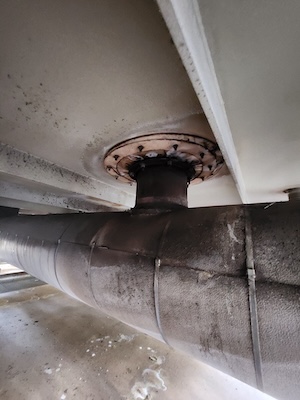
System-Level Diagnosis Instead of Component-Level Repair
A turnkey contractor familiar with pressure parts, liners, silencers, and HRSG systems assesses system interplay. Seal failures often result from liner looseness, insulation displacement, misalignment, or abnormal movement. Contractors focused solely on seal replacement may overlook systemic issues. A turnkey provider determines if the seal is the root cause or a symptom, then addresses the underlying failure.
Reduced Repeat Failures
Addressing liner and thermal issues with seal replacement extends service intervals and lowers lifecycle costs by reducing outages and repeat failures.
Single Point of Accountability
Using several contractors can create gaps and disputes: one replaces seals, another repairs liners, and a third handles pressure parts. Repeated failures blur accountability. A turnkey approach consolidates all work under one contractor, simplifying management and placing responsibility with a single party.
Efficiency During Outage
Penetration seal work is best combined with pressure part repairs, drain work, catalyst work, or panel replacements. Bundling reduces costs, shortens schedules, and improves coordination. A comprehensive outage plan increases efficiency and lowers total cost compared to separate jobs.
Broader Experience Base
A nationwide contractor servicing many HRSG units gains experience with diverse turbine designs, exhaust conditions, and failure modes. This breadth improves decision-making, enabling individualized solutions rather than default repairs based on comparable cases.
Proactive Risk Identification
During the evaluation of penetration seals, a turnkey contractor may identify unrelated but emerging issues such as casing hot spots, insulation degradation, or liner system disruption. Correcting these during the same outage prevents future downtime events. A superficial repair approach rarely includes this broader inspection.
Operational Impact
The main advantage is continuity. Proper turnkey repairs reduce unplanned downtime and provide the following plant benefits: lower repeat maintenance costs.
- Minimize safety exposure from extremely hot gas leakage.
- Improve extended reliability.
Treating penetration seals as indicators of system health, not just replaceable parts, drives greater reliability and long-term results.
If you have a penetration seal issue, respond quickly to avoid downtime. Partner with SVI BREMCO for comprehensive repairs that ensure reliable, long-term performance.