
Written by Will Medlock | Power Plants
Combustion gas turbine power plants typically require exhaust gas path silencing in the stack, whether in a simple- or combined-cycle arrangement. Hundreds, if not thousands, of units in the United States installed base are 20+ years old now and have failing stack silencers. In the coming months and years, sites will continue to look at retrofitting stack silencers so that gas power plants can run efficiently, quietly, and safely.
What Are the Factors to Consider When Planning a Silencer Retrofit?
Consider these points to help ensure a successful stack silencer retrofit project that will perform exceptionally well for years to come:
Materials of Construction
While stack silencer materials of construction have changed over the years, there is a short list of common materials used today, including the following listed in order from least to most expensive options:
- S40930 (409SS)
- S40955 (11CrCb)
- 304SS
Material selection depends on many factors, including exhaust gas design temperature, stack span length, silencer thickness, and silencer active length. Each plant site has its own unique set of criteria for designing the stack silencer. 409SS is typically the first material to reach for due to its relatively low cost and availability. When temperatures get high and stack spans get large, 304SS may become necessary to accommodate the elevated silencer internal member stresses.
Silencer Type
A second price consideration is the type of stack silencer to be retrofitted. Generally, stack silencers are either parallel or bar baffle style:


Most OEM stack silencers are standard parallel baffle arrangements, typically the most cost-effective option for an OEM to mass produce. BAR stack silencers are a more complex fabrication and typically more costly per foot of silencer active length. Still, they are also more acoustically and aerodynamically efficient per foot of silencer active length, meaning they can provide superior performance in a smaller footprint with similar material and fabrication costs.
Stack Shape
Another consideration is the geometric shape of the stack silencer section, whether it be rectangular or circular. Circular stacks are more common due to the relative ease of OEM stack fabrication compared to the rectangular stack; however, parallel baffle silencers in a circular stack are much more complex to design and fabricate than rectangular stack silencers. A circular stack profile means each baffle pair has a unique length and unique brackets to mate with the arc of the stack shell, as shown below:
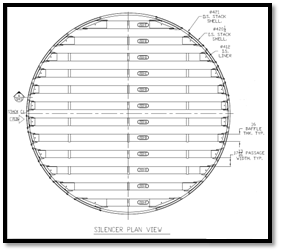
In contrast, the silencer baffles and their brackets in a rectangular or square gas path stack are identical. Fabrication becomes much more straightforward in this case, with substantially fewer unique parts to cut and form, more repetition in fitment and welding, and simpler shapes than the circular stack.

Unfortunately, the stack shape cannot be easily changed without installing an entirely new stack, which has been done in highly specific circumstances. Being aware of the stack shape and its implications when planning a stack silencer retrofit is valuable, nonetheless.
What is the Cost of a Stack Silencer Retrofit?
There are tens, if not hundreds, of variables impacting the cost of a stack silencer retrofit project concerning the details of the scope, including outage length, work shifts, time of year, silencer vendor, whether brackets are being replaced, whether an “in-kind” new silencer is being installed, and many others. Some are more intuitive than others:
- Outage length can drastically impact project cost and directly relate to work shifts. If an outage were unlimited (wouldn’t that be nice!), a smaller crew could work Monday through Friday during standard working hours to keep labor costs low. Conversely, compressed outage schedules tend to necessitate around-the-clock schedules, including weekends and larger crews (which are less efficient on the margin).
- Whether brackets are being replaced or not can change a project’s cost by as much as two or three hundred percent. At times, unlined stacks behind HRSGs will have simple brackets that can be inspected and deemed acceptable for re-use. Generally, lined stack silencer retrofit scopes will include bracket replacements due to the elevated temperatures in these stacks.
- Different silencer vendors can drastically impact project costs, both in the immediate term at the project level and in the longer term, depending on how effective and durable the new silencer is. Look for a vendor with expertise in all aspects of silencer retrofits, including acoustical engineering, structural engineering, project management, fabrication, quality, site work, and safety, for the most streamlined and efficient project from start to finish.
- Lastly, “in-kind” versus alternative silencer design considerations are essential when looking at a stack silencer retrofit project. At times, OEM silencers are undersized or oversized for their application, opening the door to revisit the design in the aftermarket for cost-effectiveness while also improving pressure drop and reducing flow velocities through the silencer. At many sites, an aftermarket silencer can utilize five baffles instead of the OEM six baffles, significantly reducing fabrication and fieldwork costs. Be sure to use a vendor capable of validating their aftermarket silencer designs with experience, references, and post-retrofit site noise testing.
Does Your Gas Turbine Power Plant Need a Stack Silencer Retrofit?
At SVI BREMCO, we understand that each turbine exhaust system retrofit project presents unique performance and structural challenges. Thoroughly analyzing each unit and creating tailor-made plans is essential. Our engineers are experienced in designing individualized solutions for exhaust system retrofits that optimize system performance, minimize plant downtime, and maximize durability and longevity. Contact one of our experts today to find the right solutions for your gas turbine power plant’s needs.