

Written by Samir Baydoun | Power Plants
Managing the noise generated by gas turbines is a top concern for numerous organizations. It’s crucial to have the necessary noise control measures in both the atmospheric inlet and exhaust openings of these turbines to ensure compliance with relevant noise standards.
Why Is Silencer Baffle Material Selection Important?
Material selection for baffle framing and perforated sheets is crucial for the lifespan and durability of combustion turbine exhaust silencer baffles. The material selection is job-specific and depends on exhaust gas design temperature, flow design parameters, and the geometry of the silencer. At exposure to extreme temperatures, stainless steel experiences creep, and its strength becomes strain-rate dependent. At these temperatures and with constant stress, the steel strain will increase (creep) continuously over time. Eventually, the silencer frame structure will fail at stresses well below the yield strength as measured in ASTM short-duration tests at ambient temperatures. ASME II – Part D code is used to determine the proper material based on allowable stress properties for specific design temperatures. For long-term high-temperature services, the creep rupture strength of the steel becomes the primary factor in determining the allowable design stress. In addition, a limited creep rate must be considered when determining the allowable design stress. Creep and creep rupture are dependent on the chemistry of the steel. Materials such as carbon steel (A36) are susceptible to creep and creep rupture at temperatures above 750°F, while austenitic stainless steels are susceptible to creep at temperatures above 1050°F.
For combustion turbine exhaust silencers, the design for creep is based on creep and creep rupture properties for a creep life of 100,000 hours. The allowable stress used in the design should not exceed the lowest of the following values:
- The average stress to produce a creep rate of 1% in 100,000 hours with a factor of safety or 1.0.
- The average stress to cause creep rupture at the end of 100,000 hours with a factor of safety of 1.5.
Furthermore, temper embrittlement and graphitization at high temperatures will affect the mechanical properties, producing brittle characteristics that should be considered during the structural design. Temper embrittlement occurs in some steels when they are aged at temperatures between 700°F and 1,100°F. When the steel becomes temper embrittled, it loses its toughness and easily cracks when stressed or impact-loaded. Graphitization occurs in steel containing relatively high amounts of carbon, such as A36, when graphite forms at the grain boundaries due to the steel being exposed to temperatures above 750°F for a long period of time. Graphitization can cause steel to prematurely fail at the weakened grain boundaries.
What Is the Allowable Stress for Different Materials?
For baffles exposed to a temperature above 800 °F, ferritic stainless steel or austenitic stainless steel can be used in the design of baffle frames and support brackets. There are three primary materials in the industry used for this application, including S40930 stainless steel (commonly known as 409SS), S40955 stainless steel (commonly known as 11Cr-Cb), and 304SS stainless steel. The table below lists the allowable stress for each material at 1250 °F as listed in ASME II – Part D and extrapolated from manufacturing data sheets:
| Material | Type | ASME Code Mat’l? | Allowable Stress @ Design Temp (1250 F) |
| S40930 | Ferritic | Yes | 1.28** |
| S40955 (11Cr-Cb) | Ferritic | No | 1.44** |
| 304SS | Austenitic | Yes | 4.7* |
* Stress value obtained from ASME II – Part D code.
**Stress values were extrapolated from manufacturing data sheets.
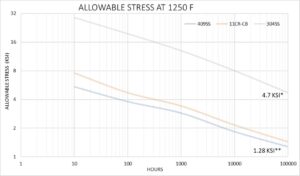
*Stress value obtained from ASME II – Part D code.
**Stress values were extrapolated from ASME II – PART D code and from manufacturing data sheets.
S40955 (11Cr-Cb) was developed many years ago to slightly increase oxidation resistance over S40930 by adding higher levels of silicon (Si). Higher silicon contributes to lower ductility, and it does not significantly improve material strength at elevated temperatures. The resulting decrease in ductility can cause microscopic cracking problems during fabrication and welding. Also, the material producer cautioned designers and fabricators about the cold-weather impact load when using heavy gauge (11ga) with welds due to the Ductile-to-Brittle Transition Temperature (DBTT) being close to ambient temperature (reference material datasheet from Cliffs). This may cause cracks in the weld Heat Affected Zone (HAZ). It is worth mentioning that S40955 (11Cr-Cb) is produced in gauge-thickness material only (maximum thickness produced is 0.115”).
Final Thoughts About Silencer Baffle Materials
The selection of materials for combustion turbine exhaust silencer baffles is a complex process crucial for ensuring structural integrity and long-term performance. Factors such as creep, creep rupture, temper embrittlement, and oxidation resistance must be carefully considered to mitigate the risk of premature failure. By adhering to standards such as ASME II – Part D and leveraging material-specific data, engineers can make informed decisions to optimize the durability and reliability of silencer components.
If you would like more information about gas turbine exhaust silencers or baffles, contact SVI-BREMCO and speak with one of our experts. We are here to help.