
Written by Kory Cooper | Plant Maintenance
Exposure to hazardous noise causes hearing loss in millions of adults. The cumulative effects of a noisy environment, sometimes called noise pollution, inflict permanent damage to the inner ear’s tiny hair cells (stereocilia). These excessive noise levels create vibrations in the stereocilia that often result in a condition known as noise-induced hearing loss.
The damaged hair cells are neither replaceable nor do they regrow on their own. Once damaged, they no longer trigger electrical signals to the brain, hindering an individual’s ability to hear correctly. And while noise-induced hearing loss can originate from various sources, those working in the manufacturing sector are particularly vulnerable.
To counteract the effects of loud machinery and noisy manufacturing floors, many companies use industrial silencers to diminish the risk and assist in acoustical attenuation. Different industrial silencers are working to decrease noise levels, but to understand how they help, it’s essential to comprehend acoustic attenuation.
What is acoustic attenuation?
Acoustic attenuation refers to the reduction in sound intensity as it travels through various materials. The sound waves are distributed and weakened in two ways: The first is through acoustic absorption, in which porous materials absorb sound waves and transform the sound energy into heat energy that is dispersed into the atmosphere.
The second acoustic attenuation method is scattering, which redirects sound waves from their original path. The waves might even be reflected toward the actual noise source.
Acoustic attenuation combines both methods to minimize noise volume. Some industrial silencers utilize a combination of absorption and scattering to attenuate sound in manufacturing environments.
What are the four primary types of industrial silencers?
While industrial silencers appear in various shapes and sizes, they are typically classified into four types:
- Reactive silencers: The primary function of reactive silencers is to reflect sound waves to their source. They do not employ sound-absorbing materials; instead, they utilize the principles of geometric design.
- Diffuser silencers are designed to reduce the noise created by gas or steam. They diffuse high-velocity, turbulent gas flow into a lower velocity and less turbulent flow, thereby preventing noise from being generated.
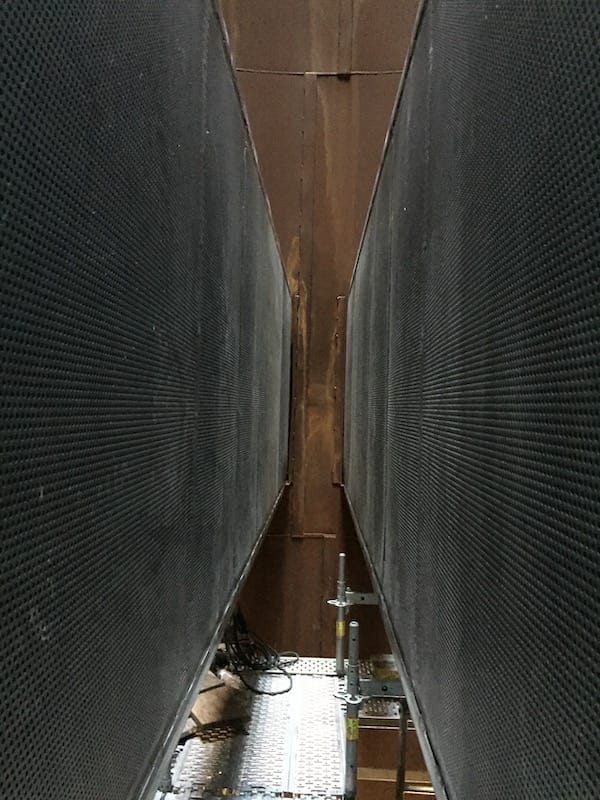
- Absorptive (dissipative) silencers: The most common type of industrial silencer, this type absorbs sound using acoustical materials that convert acoustic energy into heat energy. Absorptive silencers provide attenuation over a broad range of frequencies.
- Combination silencers: By utilizing elements from various industrial silencers, combination silencers can employ both absorption and scattering to attenuate sound, thereby providing a customized noise control solution.
- BAR silencers utilize a matrix of perforated bars packed with acoustic insulation to provide broad-spectrum noise attenuation while allowing for three-dimensional airflow. This design reduces turbulence, lowers self-generated noise, and improves structural durability under high-temperature and high-velocity exhaust conditions. Learn about SVI Bremco’s proprietary BAR Silencer technology.
Absorptive silencers are popular, but where will you find them?
Because they are effective at high noise frequencies between 500 and 8,000 Hz, absorptive silencers are used in gas turbines, centrifugal compressors, industrial fans, commercial HVAC air distribution systems, and all types of industrial ventilation systems. Since absorptive silencers can be installed vertically or horizontally, they are ideal for various power and process applications.
What types of acoustical material do absorptive silencers contain?
Acoustic absorption materials vary depending on the application and include mineral wood, glass fiber, basalt, and ceramics encapsulated in various materials, such as Mylar, Tedlar, and glass fiber cloth, tailored to specific operating conditions.
Why is customizing absorptive silencers essential to their performance?
Every properly designed absorptive silencer must have the correct number of baffles, each of optimum thickness and length. Their air passage paths must be the right size for the specific sound spectrum, flow volume, and temperature.
Since the silencer needs to reduce incoming noise, the environment in which the silencer will be used is critical. The acoustic performance will be affected by factors such as temperature, gas characteristics, system configuration, and physical layout. The silencer must also be designed to fit into the available space. Another consideration is aerodynamics since the airflow through the absorptive silencer will cause a loss of pressure, significantly affecting acoustic performance.
Keep in mind that numerous factors contribute to the design of absorptive silencers, making off-the-shelf solutions for industrial noise reduction impractical or impossible. Compounding the difficulty of finding the best design is that these factors are frequently in conflict. Because of this, you should partner with an industrial service company that understands and can design and provide innovative solutions for industrial noise control.
Turn to the experienced professionals at SVI BREMCO
Designing and manufacturing absorptive silencers should be entrusted to expert fabricators. SVI DYNAMICS, a division of SVI BREMCO, is a leading manufacturer of industrial noise control solutions for power and process applications. We utilize in-house engineering to design custom solutions to meet your acoustic, aerodynamic, thermal, and structural project goals.
Contact us today to find out how we can help you!